Andrew Freer couldn’t sleep.
The day before, his neighbor had been arrested a block from their kids' school in Oak Park, just outside Chicago. The neighbor had been doing what a lot of Chicagoans were doing in September and October of 2025: following an ICE vehicle, honking his horn and blowing a whistle to alert the neighborhood. Four agents got out of the car and drew their guns, right in front of the school, which promptly went into lockdown.
Freer, a commercial filmmaker with 20 years in the industry, stayed up thinking it through. By the next morning, he had a media plan, a mission, and a new organization: Go Fourth Media.
"I just thought, what can I do?" he told me.
What he could do, it turned out, was get out on the streets with a camera and document Operation Midway Blitz in a way that made people actually feel what was happening.
The Gap He Saw
Operation Midway Blitz, for those who somehow missed it (and Freer would argue many people did), was the federal government's massive immigration enforcement surge in Chicago, launched in September 2025. At its peak, some 250 immigration agents descended on the city, making over 1,000 arrests. Border Patrol agents used tear gas and pepper balls against protesters, U.S. citizens were detained, and agents set up checkpoints at O'Hare where they stopped Uber and Lyft drivers to demand identification papers. One agent interrupted a Somali man's prayers, laughed at him, and told him he "wasn't special" while running his face through facial recognition software.
Mainstream media were covering this story, too, but Freer and his small, scrappy team did something different. They learned to track the convoys, figured out how to get ahead of the agents, and kept their cameras small and their setups nimble (he keeps making them smaller, he told me, because if you want to follow ICE agents, a big camera rig isn't going to cut it). And he developed what he calls his own form of "gonzo journalism," providing voiceover context so viewers could understand what they were seeing on screen. He didn't want to make it about himself, but the urgency demanded it.
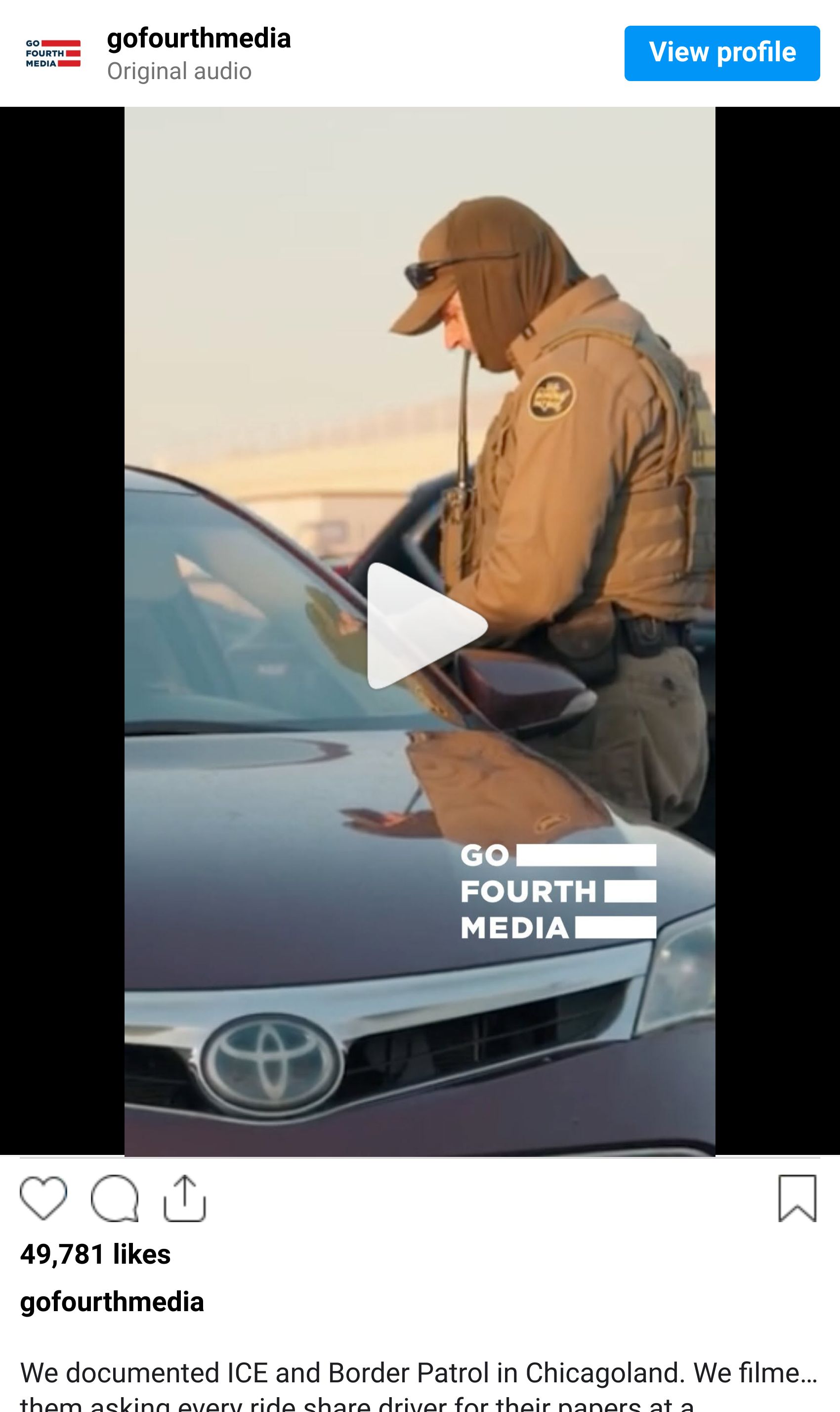
The result is some of the most visceral footage of the immigration crackdown that exists anywhere on the internet, and I'm not being hyperbolic. Go watch the Chicago checkpoint video – that includes details you won’t hear anywhere else, like the fact that ICE had their “own media” in tow to document their work.
‘If You Want to Know How It Felt, Ask a Filmmaker’
Freer's background is worth understanding, because it speaks to something we talk about a lot in this newsletter: the people doing some of the most important journalism right now aren't necessarily the people the journalism industry would credential as journalists.

(Courtesy Andrew Freer)
He grew up in a pastor's family that moved from Ohio to Indonesia when he was nine. He lived there until he was 18 before returning to Chicago for college. That experience, he says, shaped how he thinks about immigration and democracy. After school, he spent two decades in commercial video production, working on corporate documentaries, editing for the Obama campaign, and making his own independent docs (including one following an LGBTQ church in Oak Park that he shot by checking out cameras from his old school's film department because he still knew people who would lend them to him. Andrew is a man who scraps.)
He paraphrased a quote to me that I think perfectly captures his philosophy: "If you want to know what happened, ask a politician. If you want to know how it felt, ask a filmmaker."
That ethos is all over Go Fourth's work. Their interview pieces, like Eva's story and Scott's story, aren't trying to just prove something is right or wrong. Rather, they're trying to put you inside someone else's headspace. What does it feel like to be detained? What does it feel like to be shot by ICE and then have them lie about it? What is the generational trauma that follows a family after these encounters?
Minneapolis and the Knife's Edge
When ICE turned its attention to Minneapolis in January, Freer went too. What he found there, he says, was a city on the verge of something terrifying.
"I think we were less than a week away from full civil unrest in Minneapolis," he told me.
Citizens were out in their neighborhoods with weapons, people called "commuters" were on every block with whistles tracking ICE vehicles, and residents were putting up blockades in the middle of streets. Meanwhile, ICE agents were breaking down doors, going into the homes of citizens, and using tear gas liberally (Freer was gassed multiple times, which is how he learned that the half-face gas masks he'd bought weren't going to cut it and he needed full-face ones).
And then it de-escalated, which was a relief, but also, Freer says, became its own problem.
The Funding Cliff
Here's where this story intersects with something the funding and philanthropic community reading this newsletter really needs to hear:
Go Fourth Media is approaching 1.5 million views across social media – all organic, from just 10 videos. Their comment sections include people saying things like "this should win the Pulitzer Prize" and "I'm sobbing watching this." Multiple viewers have told Freer that watching his work changed how their families understood what was happening.

A sampling of comments from GoFourth’s Instagram account.
Despite doing crucial work to document these potential goverment over-reaches, Go Fourth Media has raised just $16,000 through an online donation platform called Give Butter, to cover six months of frontline documentary journalism in two American cities under crisis. The money just isn’t there to support Freer and his team doing this work in a sustainable way.
"At this point, I've had pretty much my entire post-production team say that they aren't able to donate any more time to this, understandably so,” said Freer. “So I've been filling in the gaps with post-production and some things like animation and music composition and other things we aren't able to do moving forward without any funding support."
Freer has talked to the usual journalism philanthropy suspects and been told, "this isn't specifically something we fund.” He had promising conversations with multi-millionaire donors who were very interested during the Minneapolis surge and then ghosted him when things de-escalated. A high-profile cable news team was in talks about producing content together, but interest faded when the news cycle moved on.
The recurring problem? He keeps falling through institutional cracks.
"I tell people we're both journalism and documentary and then people hear, oh, you're neither," he said. Documentary funders say he's a journalist. Journalism funders say he's a documentarian. Immigration-focused organizations say media isn't their priority. Grant cycles move too slowly for urgent on-the-ground work. And the application processes themselves are a time sink that a one-person operation documenting active ICE operations simply cannot absorb.
Meanwhile, the personal cost is staggering. Freer estimates he's putting in 40 hours a week on Go Fourth work, at an opportunity cost of tens of thousands of dollars monthly to his commercial business. He's bought gas masks, ear protection, cold weather gear for Minneapolis, and about $5,000 in specialized camera equipment. And, he is, increasingly, doing this work by himself.
"I just need, I need to be able to hire somebody at some point,” Freer told me. “Like, I can't do this all by myself. I need another full-time person – an executive director, senior producer, journalist type that can really help me move this forward."
It's Not Over
When I talked to Freer on March 25th, he had just come from O'Hare, where he counted 30 ICE agents who had been deployed there to do the work of the unpaid TSA agents who either weren’t showing for work or were overwhelmed. He was heading back after our call to interview a community member at the airport. He's currently working on a piece about Marimar Martinez, who was shot by ICE in October, and interviewing a Venezuelan family.
"It's not over," he told me. "They're changing their tactics. They're moving up asylum cases. They're still leasing offices and building warehouses to detain people. Believe what I do, not what I say."
The name Go Fourth Media started as a reference to Fourth Amendment rights being violated on the streets of Chicago. But Freer sees a bigger future for it, if he can get the support: a fourth estate organization focused on holding the government accountable through the kind of visceral, human-centered video journalism that he says legacy outlets either can't or won't do.
"The three branches of government were all pushing this forward," he said. "It's only journalism and the fourth estate and First Amendment rights that can push back against this."
He's right. And the question for funders, for the journalism industry, for anyone who believes that what happened in Chicago and Minneapolis matters and needs to be documented, is a simple one: Are you going to wait until the next crisis to care or to fund Andrew’s work?
Go Fourth's next video, about ICE agents at Chicago’s O’Hare Airport, drops on Tuesday. You can donate to support Go Fourth and Andrew's work at Give Butter.
Project C is in Chicago this week for ONA26. If you’re at the annual conference, join me, the 2026 Creator Cohort and many more people you read about here for a robust slate of creator-focused programming. Look for panels and sessions from me, Ryan Kellett, Justin Bank, Amber Sherman, Adriana Lacy, LNI Media, Rahim Jessani and so many more!
