Hi there,
I'm back from vacation! Swam with otters, ate an unreasonable quantity of ice cream, fell asleep in the sun more than once – highly recommend. Thank you for the patience while I was gone. I came back to two weeks of piled-up news, a Slack full of wins, and an important platform story. So that's where we're starting. Oh, and from now on this newsletter will be dropping on Mondays vs. Fridays. – Liz
THE NEW YOUTUBE MATH

The fastest-growing YouTube audience on TV is not who you think it is. Also, are we weary of the AI-generated art here yet?
Last week, YouTube doubled the requirements to get into its Partner Program. Starting February 1, 2027, new applicants need 8,000 qualified watch hours in a year instead of 4,000 – or 20 million Shorts views in 90 days instead of 10 million. The subscriber bar stays at 1,000.
Coverage of the changes were, without exception, written for publishers, brands, and creators big enough for whom the answer is I "don't worry about it." Today, I wanted to dig into what this means for the kinds of journalism creators we work with at Project C, so we’re going to shift into classic explainer-ing mode here and get some answers.
What actually changed, and for whom
Three separate things got mashed together in the coverage. Let's pull them apart.
If you're already in the Partner Program, you're grandfathered on long-form video. YouTube's own words: "If you are already in YPP, your status is not impacted by this update." Good.
But everyone in YPP has to go re-accept updated monetization modules in Studio by January 31, 2027. Miss it and you stop earning from those features on February 1. You don't get kicked out, and you can accept late to restore. But nobody is going to chase you about this. Go do it now, or write it down somewhere you'll actually look.
The third thing is the one that bites smaller-scale creators. From February 1, earning from the Shorts Creator Pool in any given month requires 10 million qualified Shorts views over the previous 90 days. Below that you stay in the program and keep earning on long-form – your Shorts revenue just goes to zero. YouTube keeps running ads on those Shorts, incidentally.
(Separately, and unrelated to any of the above: since August 24, YouTube counts a public view the instant playback starts, autoplay included. Your view count is about to jump, but it will mean less. Eligibility and pay still run on engaged views and watch hours. Don't let a sponsor quote you a number before you both understand which one they're using. As Ashni Christenson put it: information is negotiation leverage.)
Now the math
Say you've got 2,000 subscribers and you publish a weekly eight-minute video. Fifty-two a year if you’re working at a regular cadence. Retention on an eight-minute video runs somewhere around 45%. So call it 3.6 minutes watched per view, which is 0.06 watch hours. To clear 8,000 hours you need roughly 133,000 engaged views a year. Divide by 52 and that's about 2,560 engaged views on every single video, every week, forever.
At 2,000 subscribers, that's around 128% of your subscriber count, per upload. The old bar was closer to 1,280 views per video. So things got harder.
Here's the good news, though: length is a lever. A 20-minute video at 30% retention gives you six minutes watched (0.1 watch hours per view). Now 8,000 hours takes 80,000 views a year, or about 1,540 views per video. Half the audience for the same threshold. Investigations, explainers and long interviews actually may be the cheaper path to the threshold. Depth is being rewarded here, which is the opposite of the become-twice-as-viral panic.
And then: what's actually behind the door
News and politics content carries a median RPM somewhere around $2.60 – roughly a quarter of what education and science pulls – because advertisers exclude news and political content by default, which thins the bidding pool to almost nothing. News also gets essentially no fourth-quarter lift. (There is no holiday season rescue coming!) So: 133,000 views at $2.60 per thousand is about $346 a year – $29 dollars a month. That is the prize on the other side of the threshold everyone is panicking about. 😬
Now hold that next to this. At those same 2,000 subscribers, 20 channel members at $4.99 a month – YouTube takes 30% – comes out to roughly $838 a year. Two and a half times the ad revenue. From one percent of your subscribers. And it's available starting at 500 subs.
This is the part I think I have right, but would love someone to confirm:
The expanded Partner Program tier didn't change at all. YouTube said so explicitly: "There are no changes to the eligibility requirements for fan funding, YouTube Creator Partnerships, or YouTube Shopping." That tier needs 500 subscribers, three public uploads in 90 days, and either 3,000 watch hours over 12 months or 3 million Shorts views over 90. It unlocks memberships, Super Thanks, Super Chat and Shopping.
So 3,000 watch hours at 500 subscribers is an easier gate than the old 4,000 at 1,000. If you take one action from this issue, I'd make it that one and not the application scramble.
Though do the scramble too, if it applies to you! If you're sitting between 4,000 and 8,000 watch hours right now, applying before February 1 locks you in under the old bar. Reviews take about a month, so realistically you want that application in by early December.
One more thing, because it upends an assumption
I heard Jim Vandehei mention on The Grill Room that YouTube's fastest-growing audience on television is people over 65, and it stuck with me enough that I went and checked. It holds up. Per Nielsen, viewing from adults 65 and up nearly doubled over two years – up 96% – going from 7.89% of YouTube's TV viewing in 2023 to 15.4% in 2025. That puts them roughly neck-and-neck with kids aged two to 11.
The entire creator conversation runs on an assumption that the audience is a teenager holding a phone. Wurl's Dave Bernath, who works this data professionally, said: "I would expect a lot of young people to be watching YouTube on TV. And they are, but from an indexing standpoint, it's actually the 35 plus crowd where television is their primary device for YouTube."
That changes three practical things:
What you make: long-form and lean-back beats snackable.
How much the Shorts change should scare you: less than you feared.
How you sell a sponsorship: you are not selling youth reach, you're selling an engaged older audience that advertisers chronically underprice.
It also demolishes the idea that going independent means abandoning the audience that used to watch the evening news. They're still there – just watching courtesy of YouTube vs. cable.
So what do you actually do
Not "get twice as viral." That's not a strategy, and I'll let Joey Gagliardi of G&B Digital Management say the rest.
"The thing I'd hate for creators to take away from this is, 'Great, now I need to become twice as viral.' That's not a strategy. To me this reinforces the importance of creators understanding the business underneath their audience – what they're actually good at, what their audience responds to and which revenue paths make sense for them."
Do these things:
Turn on memberships.
Make the longer thing.
Know which number your sponsor is quoting.
And, if you're close to the old threshold, get the application in by December.
The platforms will keep moving the goalposts – that's the one durable prediction anybody can make here. The subscriber who pays you five dollars a month because they trust you doesn’t move.
Now tell me where I got it wrong for your channel. I'd genuinely like to know what these thresholds look like from where you're sitting. Reply to this email, or bring it to the Slack if you're a member.

Applications are open for the EMEA cohort of the Journalism Creators Startup Lab — a free eight-week program for early-stage creator journalists across Europe, the Middle East and Africa, run with the Google News Initiative. If you're building something and you're early, this is the one. Deadline: midnight ET, Friday, September 4.
🔥 THE LATEST THINGS
Two weeks' worth, so this one runs long.
The Athletic is formally teaming up with sports creators. A legacy subscription outlet building distribution around independent creators instead of competing with them. Useful mostly as a template for what these deals look like structurally. Nieman Lab
Who actually controls your AI exposure. Yoni Greenbaum’s clear-eyed look at how much of your visibility in AI answers is in your hands versus someone else's. Worth reading before you spend a weekend on "AI SEO." Backstory and Strategy
Wall Street's newest obsession is a newsletter written by two 17-year-olds. File under: the audience does not care about your credential, it cares whether you're useful. New York Post
Apple may start paying publishers to deliver news through Siri. The terms will matter enormously – watch whether independents are eligible at all, or whether the pool only opens to big brands. Nieman Lab
Independent journalists in India are calling sweeping Instagram takedowns a "digital emergency." Opaque, unappealable restrictions hitting news accounts and satirists hardest. The clearest argument of the fortnight for not letting one account be your entire distribution. Alt News
Police fusion centers are monitoring independent accounts that document license-plate-reader surveillance. Jason Koebler's reporting names specific TikTok and Instagram accounts. Relevant to anyone doing accountability work from a personal account with no institutional legal cover behind them. 404 Media
Scott Carney: "The Real Reason that Substack is Collapsing." His diagnosis is subscription fatigue – as the platform floods the zone with free content through Notes, video and AI clipping, the incentive to pay for the paywalled work erodes, and writers end up fighting over a pie that stopped growing. Magnetic North
CBC takes stock of Substack's controversies and its future – a mainstream-broadcaster look at the platform a lot of you live on, moderation warts included. CBC
Alex Ip built a starter pack of AI-slop-free news outlets – and you have to earn your way in. Inclusion requires a documented editorial policy or leadership statement against AI text, image, video and audio. A trust signal you can actually point at. Bluesky
🤗 FROM THE PROJECT C COMMUNITY
Julie Holstein took her first week off in what she counts as 49 straight weeks of publishing hyperlocal – and throwing Ward 6 a one-year birthday party in September. 🎂
Hanna Raskin turned a vacation brainwave into a Nieman Lab story in three days: The Food Section will now only accept pitches by phone, as a response to the AI pitch deluge. Her own verdict: "Not sure if I solved a problem or created a bunch of new ones." 📞 Nieman Lab
Rose Thomas Bannister relaunched mododibere.com, migrating off a Squarespace + beehiiv + Patreon patchwork onto Ghost, with Outpost for automations and paywall and Magic Pages for hosting. Her reason for going open source: "hopefully insulated from a lot of enshittification." 🔥
Ulrike Langer's 50%-off summer sale brought six new paid subscribers to News Machines – which sounds small until you hear it's 25% of her total paying subs. She also wrote a translation skill so her German edition sounds like her and not like a machine.
Becky Bullard got a local jewelry maker to pop up at her podcast launch party and donate 10% of event sales to the show. 🤠
Mythili sent her first newsletter issue in several months, with a real plan for what's next – including illustrating news stories through collage. She called it small. It isn't. 💛 Read it
Julia Barton ran her first commissioned essay at Continuous Wave. "It was a lot of work to get it in shape! But the response has been great." Sound Is a Time Machine
Rick Ellis launched TooMuchTV on beehiiv – and the issue that got the most attention was the one headlined "I have no interest in being David Ellison's stenographer." Too Much TV
Seamus Hughes ran a summer subscriber pitch drive on a whim and pulled in $4,000, plus 200 new free subscribers and 15K pageviews in an hour when an aggregator picked up his tower-dumps scoop. Moment of Truth 🎉
Matt Kiser discovered that roughly 75% of six weeks' worth of new WTFJHT "subscribers" were bots hitting Mailchimp's legacy endpoint from Estonian datacenters – and engineered his way out with a Cloudflare Worker, Turnstile and double opt-in. If you run your own list, ask him about it. 🔧
Izzie Ramirez made it through the "Shark Tank version" of American University's Freedom Media Innovation Lab pitch competition after three straight months of work – and credited this community for answering her sponsorship questions days beforehand. 🥰
Monique O. Madan was interviewed about her investigative work and the road to founding her own thing, and gave Project C a lovely shout-out. 🧡 Listen
James Cave got tired of paying for a link-in-bio tool, so he built one that pulls RSS from both his newsletter and his podcast and shows him who subscribes through it. Take a look
Welcome to two new members: Constanza Eliana Chinea, a political creator and journalist in LA going fully independent after two years of censorship issues in traditional media (Instagram), and Chase Cain, a meteorologist and former NBC News climate reporter whose latest is a YouTube piece on regrowing a forest after catastrophic wildfire. 👋

Members get at least one live event a month, usually more. All times ET.
Thursday, September 3 · 12 PM · Cracking PACER: Tips for Telling Stories with Federal Court Records. Court Watch's Seamus Hughes on navigating the antiquated federal court records system to break stories. RSVP →
Wednesday, September 9 · 12 PM · Values That Speak. Storytelling coach Megan Finnerty walks you through composing a true, first-person story about who you are, what you do, why it matters, and how all of that lines up with your own values. RSVP →
🎤 And here's where I'll be this fall. Come say hi:
Thursday, September 10 · I'm on a panel at INMA's Young Audiences Summit (virtual), alongside Nicolas Copano, Sofia Bliss-Carrascosa and Kerstin Hasse.
September 17–18 · ISOJ in Austin, paneling with LNI’s Micah Gelman and indie journo Aaron Parnas.
October 2–4 · JAWS CAMP in Santa Monica.
October 7–9 · The Blue Engine’s Local News Camp in Durham, NC.
Ready to build alongside 250+ creator journalists? $39/month gets you the private Slack, members-only events and every replay in the Replay Room. JOIN NOW →
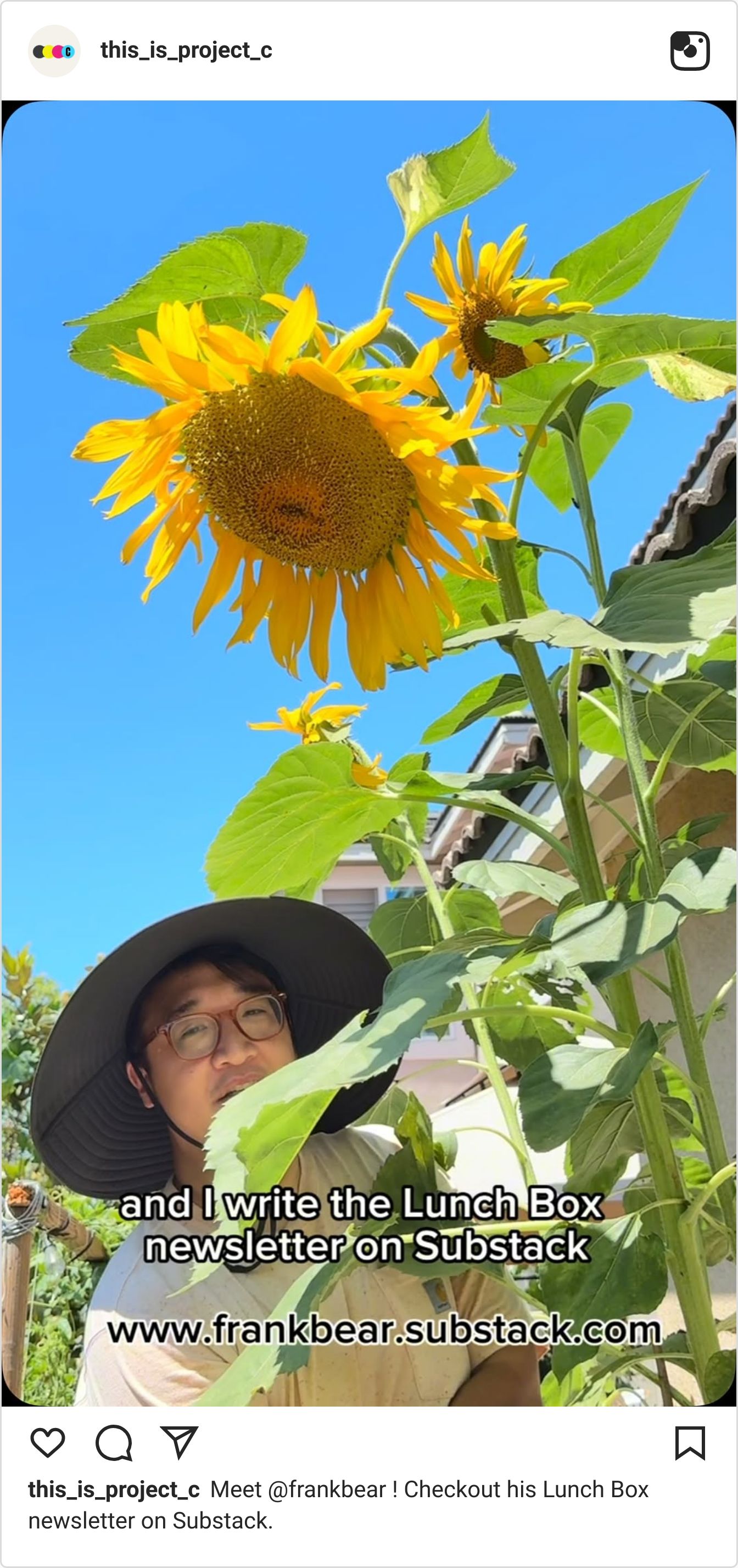
That's two weeks in one. See you next week. In the meantime, check out the latest video from our Journalism Startup Lab North American cohort member, Frank Shyong:
– Liz


How this newsletter is made: A human (hi, it's Liz 👋) writes, edits and makes every editorial call here. I use Claude, Anthropic's AI assistant, as a research tool — each week it sweeps my sources and assembles the first draft of the links roundup. Every link and every word gets a human read before it reaches you.
