A quick note before we dive into today’s newsletter: One thing we’ve learned over the past two years of supporting creator journalists: At some point, what you actually need is someone who can help you think through how to level up your specific business. That’s why Project C now offers 1-on-1 coaching led by the amazing Blair Hickman. I’m excited about this because not only has Blair – who was one of my favorite colleagues at Vox and is one of my go-to collaborators now – worked as an operator, manager and leader across all parts of a media business, from editorial to audience to business, but she’s an incredible coach (I know this because she’s been coaching me off and on for years!). She’s opened a handful of spots this summer for creator journalists who want a senior-level thought partner. It works for people at all phases of the business, whether you’re just starting or have hired a few folks.
If you're not sure whether it's the right fit, a discovery call will tell you. (It's a conversation, not a sales pitch. Promise. That’s Blair in the pic below. She’s as approachable and warm as she looks. Promise.)

Dark money is finding its way to creator journalists
Last year, Project C started work with a journalist who was leaving a traditional news organization to launch an independent project focused on the next presidential election. It was really fun. We were taking all of the theory from Project C’s research and our Going Solo workshops and applying it directly with one creator – an incredible opportunity to actually test our process.
Project C had been hired by a management company with funding from a philanthropist who believed in this project and its ability to help shine a light on an undercovered part of the 2028 race. We did, too. As the project got underway, Project C underlined the importance of transparency around funding and we were told that we would figure it out down the line. As we got closer and closer to launch, it became clear that the underlying funder was not open to disclosing their support of this project.
Whether the funder’s reasons were benign or malignant was of no consequence to me, as I believe in practicing what I preach: full transparency around funding for any creator journalism project.
In the end, we had to walk away. Project C took a real financial hit, and leaving the journalist to get to launch without us felt genuinely awful. The project debuted on schedule – without disclosing where its funding came from. We wish the journalist and the project well, but this is exactly the kind of thing that erodes and abuses audience trust.
This is a story we are seeing over and over and over.

From paragon to paradox
Last week, Carlos Eduardo Espina did something that most paid political influencers don't do. The Texas-based creator with 14 million TikTok followers who The New York Times once touted as a one-man TikTok Telemundo, confirmed publicly that he had been paid by Tom Steyer's California governor campaign to the tune of $400,000, according to financial disclosures. In a more recent New York Times article, Espina told the Times he didn't think he needed to disclose anything, because the postings signaling support for Steyer were being done on his own, not as part of any payment. The payments, said Espina, were for unspecified consulting work for the campaign. Hmm.
Now, California's Fair Political Practices Commission is investigating whether this violated state transparency rules. The Steyer campaign, for its part, says they told all the influencers they worked with to include disclosures in their posts – and that the obligation to disclose was on the creators.
And while Espina's admission makes him more transparent than most of the people doing what he did, that still doesn't make what he did right.
This is just the latest example of a problem that the creator journalism world needs to continue reckoning with directly and urgently: ethics and credibility – and how independent journalistic creators signal both of those to their audiences.

Last August, Taylor Lorenz published a piece in Wired revealing that Chorus – an arm of the Sixteen Thirty Fund, a progressive dark money network that distributes more than $100 million a year – had quietly been recruiting and paying liberal political influencers since spring 2025. Monthly stipends ranged from $250 to $8,000. Per Lorenz’ reporting, the contracts were explicit: don't tell anyone. Participants were required to give Chorus advance notice before interviewing prominent sources, and were prohibited from disclosing their relationship with the organization.
California passed a disclosure law in 2023 specifically to address this. But Senator Tom Umberg, who authored California's 2023 disclosure law, told CalMatters that paid influencers in politics are more prevalent than three years ago. “Transparency is like whack-a-mole,” he said. “Every year there's a new modality, and so there's a new way to get around stuff.”
In December 2024, Julia Angwin published a paper out of Harvard's Shorenstein Center called "The Future of Trustworthy Information: Learning from Online Content Creators." (Angwin now directs the Shorenstein Center's Independent Media + Audience Project, which is actively working on what standards and practices should look like for independent media.) The paper lays out a framework for trust built on three elements: ability, benevolence, and integrity. What Angwin found is that creators have become really good at building external-facing trust. They narrate their expertise, respond to audience questions, show their work, engage with critics. They operate in a low-default-trust environment and have had to earn every bit of credibility they have.
Angwin notes that several of the creators she spoke with – including TikTok doctor Mohammad Siyab Panhwar – have made a deliberate choice not to take brand deals at all, because audiences are skeptical of them. "It's more credible if I don't monetize my content," Panhwar told her. When YouTuber Tim Pool was revealed to have secretly taken payments from Russian operatives, his own comment section turned on him.
The creator economy's accountability mechanism is the audience. And the audience is watching.
The problem, though, is that political payments are harder to see, harder to regulate, and as the Espina situation shows, harder to even define. Was the $400,000 for "strategic advice and campaign surrogacy," as Espina said? Or was it for posting favorable content? How can he even make that distinction? The line between a creator sharing a genuine political opinion and a creator being paid to share a political opinion is invisible to audiences if no disclosure is made.
Project C and many other entities and individuals are asking consumers to bet on the future of news as independent and produced by personalities. If we're going to do this credibly and responsibly, getting this right matters a lot.
—--
Good eggs
I’m not here to proscribe rules for influencers. But creator journalists have built their credibility on a different architecture – based on audience trust rather than institutional authority. Their credibility is entirely personal. When it's compromised, it's gone.
I've talked with several journalists working in the creator ecosystem who are telling me they're getting more and more of these offers for paid deals. Not a surprise that journlalists working in the creator ecosystem would be treated similarly to run-of-the-mill influencers whose standards are just different. In every case, I advise them to steer clear. These arrangements are becoming normalized. And many of the creators entering into them are struggling to make ends meet with reader revenue, sponsorships, and philanthropic support still developing. And because journalists have traditionally been so segregated from the business side of journalism, they’re entering into these deals without fully understanding what they're risking.
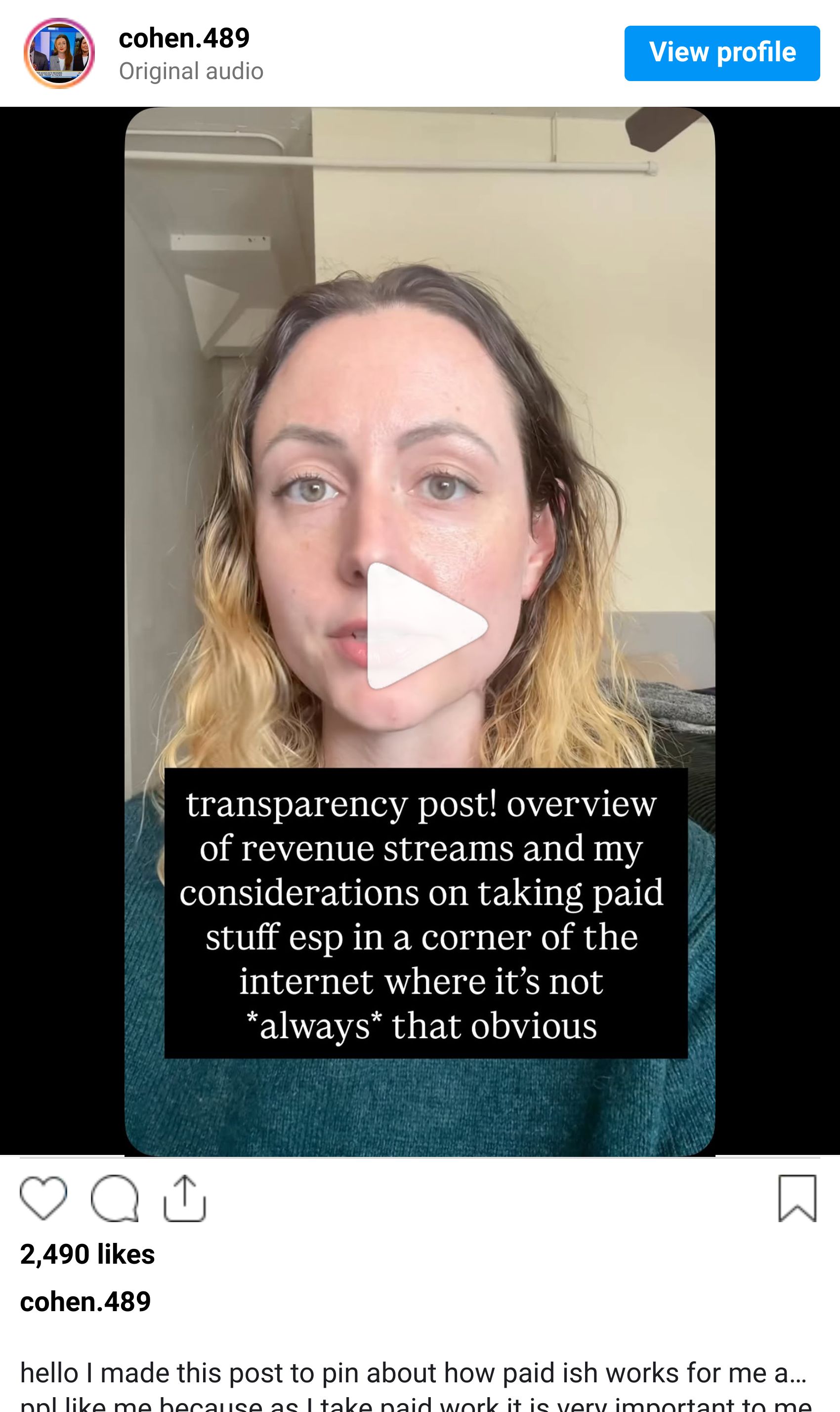
Some people are modeling what good looks like: Chicago-based content creator Rachel Cohen breaks down various funding mechanisms (and which ones she uses) in this Instagram story:
LNI Media, the independent journalism outfit founded by Dave Jorgenson and fellow Washington Post veterans Micah Gelman and Lauren Saks, has a public ethics and transparency pledge that explicitly covers funders and editorial independence. Isaac Saul’s Tangle, which prides itself on its lack of bias, states clearly in its advertising policies that Tangle does not accept political ads.

Local News International’s crystal clear policies.
What I don't have is a good example of a creator journalist who has explicitly disclosed political payment in a model way – because, honestly, I'm not sure that model exists. The best practice right now is mostly: just don't take the money. Which is a fine principle, but not a very practical one when a well-funded campaign is offering a creator with a few hundred thousand followers $25,000 to mention them in a post.

This is the right conversation to be having now, before these arrangements become so normalized that disclosure feels quaint – especially as we careen toward the 2028 presidential election, when many first-time voters are getting their political information primarily from the creator ecosystem.
It's why Trusting News and Project C developed this toolkit for Lenfest to help funders navigate finding credible, trustworthy creators. It's why one of the six courses we teach as part of our Going Solo Creator Journalism Workshop is devoted entirely to ethics and credibility and trust, taught by Lynn Walsh from Trusting News. It’s why the Project C community talks about editorial independence and best practices constantly. It’s why I continue to work with the Trusting News team on studying and understanding how trust is built in the creator ecosystem. And it's why I continue to support the work that Julia Angwin is doing out of the Shorenstein Center.
Espina's transparency about taking the money is actually useful, even if the situation itself is a cautionary tale. It gives us something to point to and say: this is the line, and here is what it looks like to cross it.
I’d love to hear your thoughts on All of the above and how we should move forward with continuing to develop ethics and credibility standards for creator journalism. Either add a comment or reply to this email.
🔥 the latest things
📌 Joanna Stern left 12 years at the WSJ to build something from scratch — a beehiiv newsletter, a YouTube channel, subscriptions, sponsorships, and an NBC deal that lets the network use and customize her content. This new Nieman Lab profile is the fullest account yet of how she's thinking about the business. 👉 Nieman Lab (ICYMI, also catch Joanna on these podcasts: 🎧 Hard Fork, On with Kara Swisher, Decoder)
📌 Joe Posner is calling YouTube the new public television — The Vox Video co-founder launched Dream On, a monthly documentary series about communities fighting poverty, incubated at Harvard and funded by foundations. He's building what he thinks public media should be on the platform where the audience actually lives. Episode one is up. 👈 Harvard Gazette
📌 Jim Waterson (former Guardian media editor, now running London Centric) posted on LinkedIn asking the question everyone thinks about and almost nobody answers: "How much do you actually make from doing independent journalism?" The thread is the story. 👉 LinkedIn
📌 Google I/O dropped a pile of AI creator tools: Canva-competitive design, Workspace AI integration, a mobile AI Studio app. Will they be useful? You tell me. If you’re an independent creator actively using AI in your work, like Alex Heath, I’d love to hear from you. Just hit reply to this email. 👉 Google I/O 2026
📌 Congrats to Johnny and Iz Harris and the NewPress team on their News & Documentary Emmy win! 👉 LinkedIn
📌 Geoff Fowler is leaving the Washington Post to launch his own Substack covering AI and its effects on kids and families. 👉 Substack
📌 Substack wants you to trust their app more than your email list — Substack's Head of Design publicly argued creators should rely on the Substack app over email for audience ownership. Tyler Denk at beehiiv wrote a detailed rebuttal: algorithmic feeds, 10% take-rates, platform lock-in, no data portability. Yes, he runs a competitor. The argument is still worth your time. 👈 Big Desk Energy

📌 NPR lost 28 more – The 2026 journalism layoff wave is already worse than 2025. Don Gonyea, Vickie Walton-James, Joe Shapiro, and Nell Greenfieldboyce are among the names walking out the door this week, as NPR tries to fill an $8M hole left by the elimination of federal public media subsidies. 👈 NPR
📌 YouTube pulled $60B in 2025 (more than Netflix!) – Brand relationships there last 13.5 months on average, vs. 7.7 on Instagram and 4.9 on TikTok. For video-forward creator journalists, YouTube is far and away the most durable business platform in the space. 👈 Creator Spotlight

New to Project C: 1-on-1 Coaching
Feel overwhelmed running or launching your creator journalism venture? Wish someone senior level was around to help you solve problems? Or help you learn new business skills without having to sift through 30 internet guides? Not sure your AI agent is steering you in the right direction? The good news is you don’t have to figure it out alone (or with a robot). 1-on-1 coaching from Project C with the very much human Blair Hickman will get your skills and your business to the next level in a supportive way.

